4.MD.5:
Measurement And Data
Geometric Measurement: Understand Concepts Of Angle And Measure Angles.
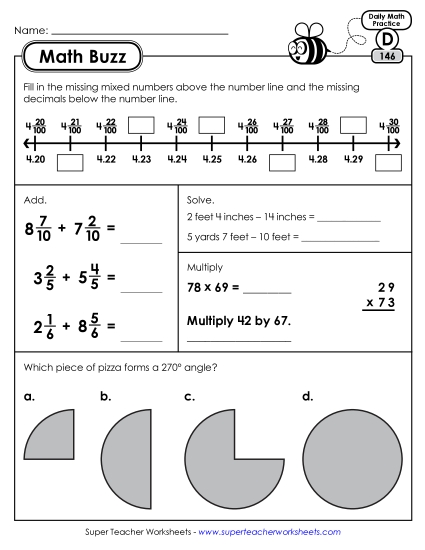
Recognize angles as geometric shapes that are formed wherever two rays share a common endpoint, and understand concepts of angle measurement:
4.NF.6:
Number And Operations - Fractions
Understand Decimal Notation For Fractions, And Compare Decimal Fractions.
Use decimal notation for fractions with denominators 10 or 100. For example, rewrite 0.62 as 62/100; describe a length as 0.62 meters; locate 0.62 on a number line diagram.
4.NF.7:
Number And Operations - Fractions
Understand Decimal Notation For Fractions, And Compare Decimal Fractions.
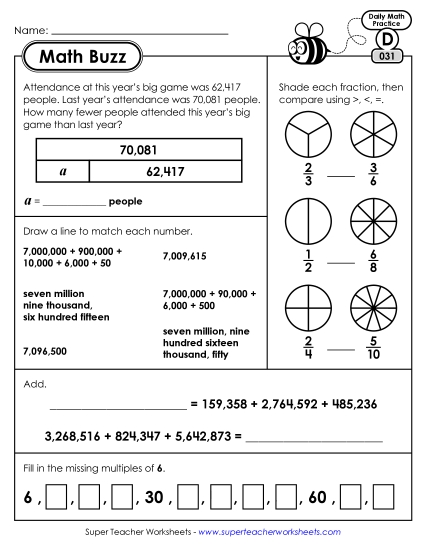
Compare two decimals to hundredths by reasoning about their size. Recognize that comparisons are valid only when the two decimals refer to the same whole. Record the results of comparisons with the symbols >, =, or <, and justify the conclusions, e.g., by using a visual model.
4.G.2:
Geometry
Draw And Identify Lines And Angles, And Classify Shapes By Properties Of Their Lines And Angles.
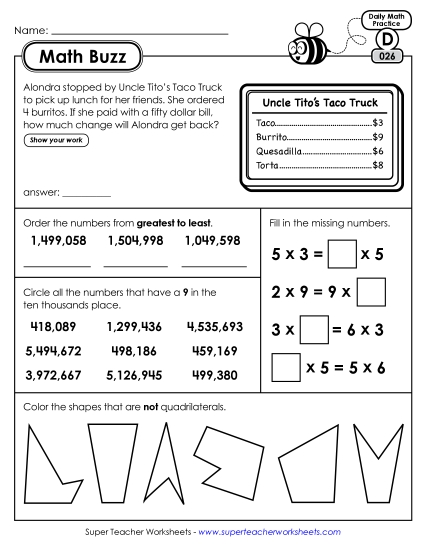
Classify two-dimensional figures based on the presence or absence of parallel or perpendicular lines, or the presence or absence of angles of a specified size. Recognize right triangles as a category, and identify right triangles.