4.NBT.6:
Number And Operations In Base Ten
Use Place Value Understanding And Properties Of Operations To Perform Multi-Digit Arithmetic.
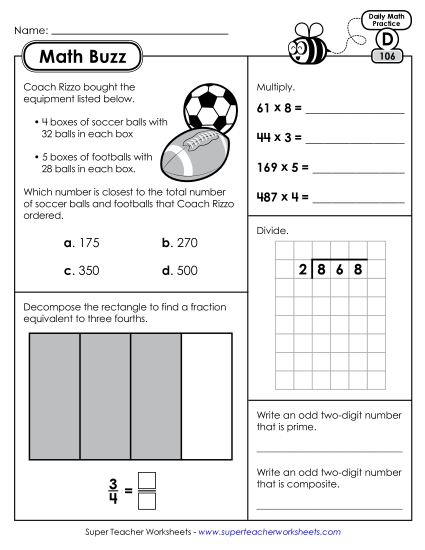
Find whole-number quotients and remainders with up to four-digit dividends and one-digit divisors, using strategies based on place value, the properties of operations, and/or the relationship between multiplication and division. Illustrate and explain the calculation by using equations, rectangular arrays, and/or area models.
4.OA.4:
Operations And Algebraic Thinking
Gain Familiarity With Factors And Multiples.
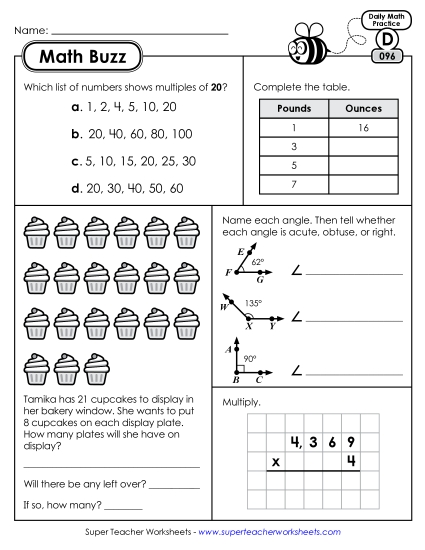
Find all factor pairs for a whole number in the range 1-100. Recognize that a whole number is a multiple of each of its factors. Determine whether a given whole number in the range 1-100 is a multiple of a given one-digit number. Determine whether a given whole number in the range 1-100 is prime or composite.
4.NF.1:
Number And Operations - Fractions
Extend Understanding Of Fraction Equivalence And Ordering.
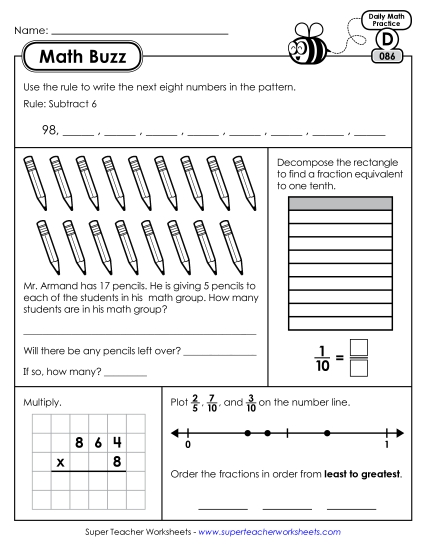
Explain why a fraction a/b is equivalent to a fraction (n x a)/(n x b) by using visual fraction models, with attention to how the number and size of the parts differ even though the two fractions themselves are the same size. Use this principle to recognize and generate equivalent fractions.
4.G.3:
Geometry
Draw And Identify Lines And Angles, And Classify Shapes By Properties Of Their Lines And Angles.
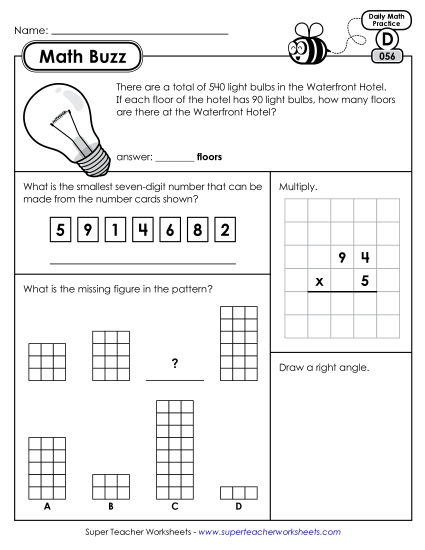
Recognize a line of symmetry for a two-dimensional figure as a line across the figure such that the figure can be folded along the line into matching parts. Identify line-symmetric figures and draw lines of symmetry.